
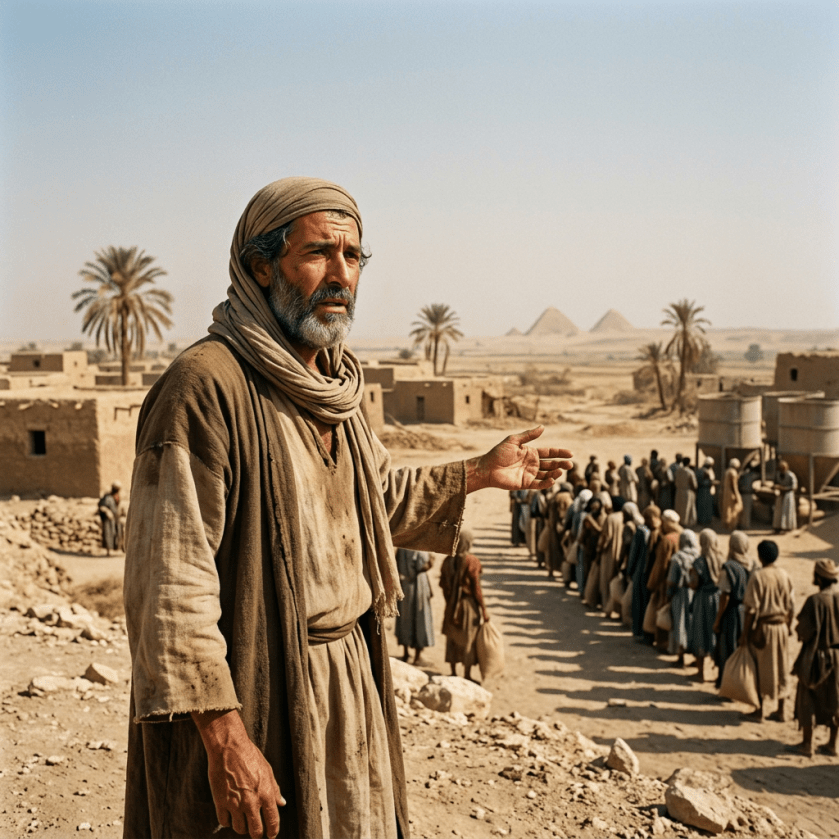
Genesis 12:10-20. 10Now there was a famine in the land. So Abram went down to Egypt to sojourn there, for the famine was severe in the land. 11When he was about to enter Egypt, he said to Sarai his wife, “I know that you are a woman beautiful in appearance, 12and when the Egyptians see you, they will say, ‘This is his wife.’ Then they will kill me, but they will let you live. 13Say you are my sister, that it may go well with me because of you, and that my life may be spared for your sake.” 14When Abram entered Egypt, the Egyptians saw that the woman was very beautiful. 15And when the princes of Pharaoh saw her, they praised her to Pharaoh. And the woman was taken into Pharaoh’s house. 16And for her sake he dealt well with Abram; and he had sheep, oxen, male donkeys, male servants, female servants, female donkeys, and camels. 17But the Lord afflicted Pharaoh and his house with great plagues because of Sarai, Abram’s wife. 18So Pharaoh called Abram and said, “What is this you have done to me? Why did you not tell me that she was your wife? 19Why did you say, ‘She is my sister,’ so that I took her for my wife? Now then, here is your wife; take her, and go.” 20And Pharaoh gave men orders concerning him, and they sent him away with his wife and all that he had.
President FDR famously said, “The only thing we have to fear is fear itself.” But what most of us know by now is that this is simply not true. Sure, it’s a nice pep talk, but the reality is that there is much to fear. For example, a famine. Famines are no joke. Or what about being murdered and your wife enslaved? Obviously Abraham thought that was worthy of his fear (and I’m sure it was).
So what are you afraid of today? And how are you processing that fear?
So far the Abraham story has been one of great faith. God calls Abraham from Ur to go to an unknown land. Great promises are made to him by God. Promises of land, offspring, and blessing. Promises that have provoked Abraham to travel through the land, building altars to God as he goes, calling upon the name of the Lord.
But then comes this strange expedition into Egypt. It’s a story of spiritual whiplash. Our hero of the faith almost immediately loses sight of everything he’s trusted so far, and takes matters into his own hands. Why? A famine. A trial. A struggle. Did Abraham think that in the Promised Land he would never face difficulty? And if the land of promise is failing him and his family, does that mean that God is failing him too? And so there is no seeking the Lord, no calling out, no altar building, and in this text the voice of God to Abraham is strikingly absent. There is not a single divine comment to Abraham in these eleven verses.
Abraham will put all of God’s promises on the line. He will leave the land behind, he will risk Sarah’s purity, and he will become a curse to the nations, not a blessing.
But it’s OK, Abraham has a plan – lie. “Say you are my sister, that it may go well with me because of you, and that my life may be spared for your sake.” Obviously, this is brilliant (yes, that’s sarcasm). If Abraham is Sarah’s husband, then murdering him is the only way to have the beautiful Sarah for yourself. But if Sarah is his sister, then there’s courtships and gifts coming Abraham’s way – that it may go well with me. This is Abraham’s plan for providing for his family. Again, faith doesn’t appear to be part of this equation. This is all about Abraham using Sarah to manipulate the Egyptians so that he can stay alive. But what Abraham doesn’t account for is the Pharaoh. The one man who has the power to simply take Sarah without asking and without bargaining.
Isn’t this what usually happens when we try to do things our own way out of fear? In our desperation to control everything, we end up in situations where we have no control. Only the intervention of God will free Abraham and Sarah from Pharaoh’s grasp, a plague and deportation – Now then, here is your wife; take her, and go.
Should Abraham have gone to Egypt in the first place? Was finding refuge there a sin? There’s mixed responses to this question among scholars. But at the very least, we must see how quickly Abraham got off track once he got to Egypt. Faith gave way to fear, and fear gave way to sin. Deception of the Egyptians and the exploitation of Sarah.
What was going through Abraham’s mind? Did he forget the promises altogether? Probably not. But did he think that in some way he had to suddenly obtain the promises that God made, that he had to take matters into his own hands in order to make sure his family was OK. Egypt offered abundance in a time of famine. Not only will my family stay alive in Egypt, we might make a profit too (off of Sarah of course). But to do this I will have to use others for my own advantage.
How often do we drift into this same mindset even as Christians? Sure, I trust God and I know I am united to Christ, but when the famines come my way (what is your current famine?), I have to do something to fix the problem, don’t I? And if that means that I have to use others, manipulate others, lie to others, and exploit others, well then so be it. Self-protection is always our main concern when we wander out of the “Promised Land” of grace and into the “Egypt” of fear.
Christian, the promises of God are never on hold. Never. Our union with Christ is never broken or even shaken. Even in the famine. The Bread of Life still rains down on us as the love of God in Christ. We never have to use others to get what we need for we have all we need in the promise of life in Jesus. Jesus, the perfect love that removes all fear.
You: Where can you see fearful living controlling your relationships?
You in Christ: In Christ we have all the love we need to remove fear. How can trusting his love more and more be applied to your specific fears today?
Christ in you: Where are you seeing yourself trust God’s promises instead of trying to use others to get what you need?
Prayer: Father, all your promises are true in Christ. Keep me standing on your promises rather than wandering into the “Egypts” that force me to use others to get what I think I need. Amen.
 To Live is Christ