Genesis 12:5-9. 5And Abram took Sarai his wife, and Lot his brother’s son, and all their possessions that they had gathered, and the people that they had acquired in Haran, and they set out to go to the land of Canaan. When they came to the land of Canaan, 6Abram passed through the land to the place at Shechem, to the oak of Moreh. At that time the Canaanites were in the land. 7Then the Lord appeared to Abram and said, “To your offspring I will give this land.” So he built there an altar to the Lord, who had appeared to him. 8From there he moved to the hill country on the east of Bethel and pitched his tent, with Bethel on the west and Ai on the east. And there he built an altar to the Lord and called upon the name of the Lord. 9And Abram journeyed on, still going toward the Negeb.
The first eleven chapters of Genesis cover a lot of territory in just a relatively few pages. Not just historically, but also spiritually. Following the fall of man in the Garden of Eden two genealogies emerged. The line of Cain and the line of Seth. Cain’s descendant, Lamech, would murder and boast about it. Seth’s descendant Lamech will father Noah, the savior of the world through the flood waters of God’s judgment.
Noah’s vineyard drunkenness, and Ham’s impropriety toward his father, will remind us that man is still corrupt to his core. Cataclysmic actions like the flood won’t solve mankind’s sin problem, a problem that grew into a tower at Babel. God can’t destroy evil without destroying us, the rainbow reminds us of that. So God will need a new strategy for redemption. And it will take shape in the call of Abraham. A new human family will be born. A family guided by promises, not commands.
This is what the call of Abraham is, a re- creation of the human family. A new Adam and Eve, a new Noah and Mrs. Noah, that will be promised land and family. Adam and Eve were created and then commanded to be fruitful and multiply and take dominion over the land. In the same way, after the flood, Noah was commanded to be fruitful and multiply and replenish the land. For Abraham and Sarah there is a command to get up and go, but not a command to multiply and take control of the earth. Instead there is only a promise. The promise of offspring and the promise of land – Then the Lord appeared to Abram and said, “To your offspring I will give this land.”
And to make sure we understand that this is not something that Abraham can do or is even being asked to do, we are reminded that his wife is the barren Sarah, and that the land is full of Canaanites. To command Abraham and Sarah to be fruitful would be cruel. Even more cruel than their childlessness. To command Abraham to dominate the land would be comical. How will this little family rule territory that is already possessed by the walled city-states of Canaan (the city of Shechem had a two-thousand-year head start on Abraham)?
And so there are no commands here, only promises. And it is the promise that provokes our worship – So he built there an altar to the Lord, who had appeared to him.
As Abraham journeys through the Promised Land, the only remains he will leave behind are the remains of his faith filled worship. Truly he has abandoned the gods of his father and has embraced the God of the promise. Like his distant ancestors before him, Abraham will begin to call upon the name of the Lord.
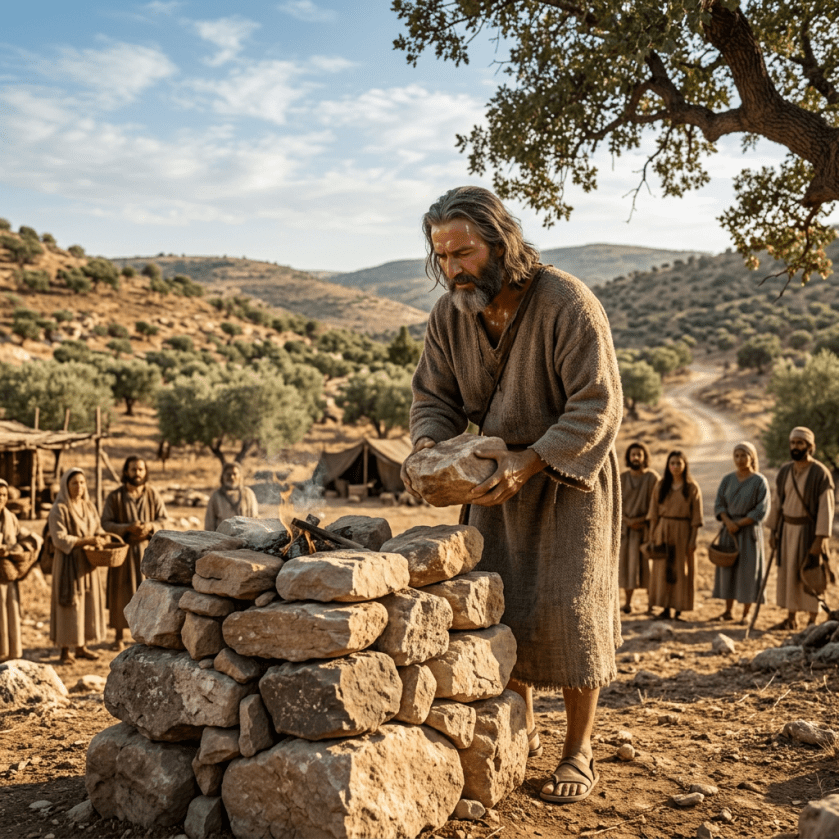
No, Abraham’s are not the first altars in the Bible. When Abraham piles rocks upon each other and kills an animal in order to be able to approach his God, he is remembering the very first promise of God. The promise of a savior. The protoevangelion of Genesis 3:15.
I will put enmity between you and the woman, and between your offspring and her offspring; he shall bruise your head, and you shall bruise his heel.
The offspring of the woman will destroy sin and Satan and restore mankind. Could Sarah be this woman? In a very real sense she is, for Jesus is the offspring of the barren Sarah. Jesus is the ultimate child of promise – to your offspring I will give this land. One day Jesus will rule all the Earth, and every knee will bow to him.
And so now our worship mimics that of our spiritual father Abraham. Our call to worship in Christ is also motivated purely by the promises of God.
Romans 12:1-2. 1I appeal to you therefore, brothers, by the mercies of God, to present your bodies as a living sacrifice, holy and acceptable to God, which is your spiritual worship. 2Do not be conformed to this world, but be transformed by the renewal of your mind, that by testing you may discern what is the will of God, what is good and acceptable and perfect.
Abraham’s altars were not built to appease, satisfy, or persuade God. They weren’t erected to earn anything from God. They were built as memorials to a promise making God, even before the promise was fulfilled. That’s faith!
Life in Christ is always meant to be a response to the promise. Faith in God’s grace. Especially his lavish grace in Christ, so that everywhere we go, we leave behind the remnants of our trust, not the remnants of our own self-righteous efforts. Everywhere we go we build spiritual altars to Jesus, not towers to ourselves.
You: Are you building altars or towers?
You in Christ: Is your worship motivated by the promises of union with Christ or by something else?
Christ in you: How might you display your faith in Christ today, what spiritual altar can you build?
Prayer: Father, even before every promise is fulfilled I will trust you. Make my life an offering to your grace and mercy. Let it be a living altar of your love. Amen.


Thank you
>
LikeLike