
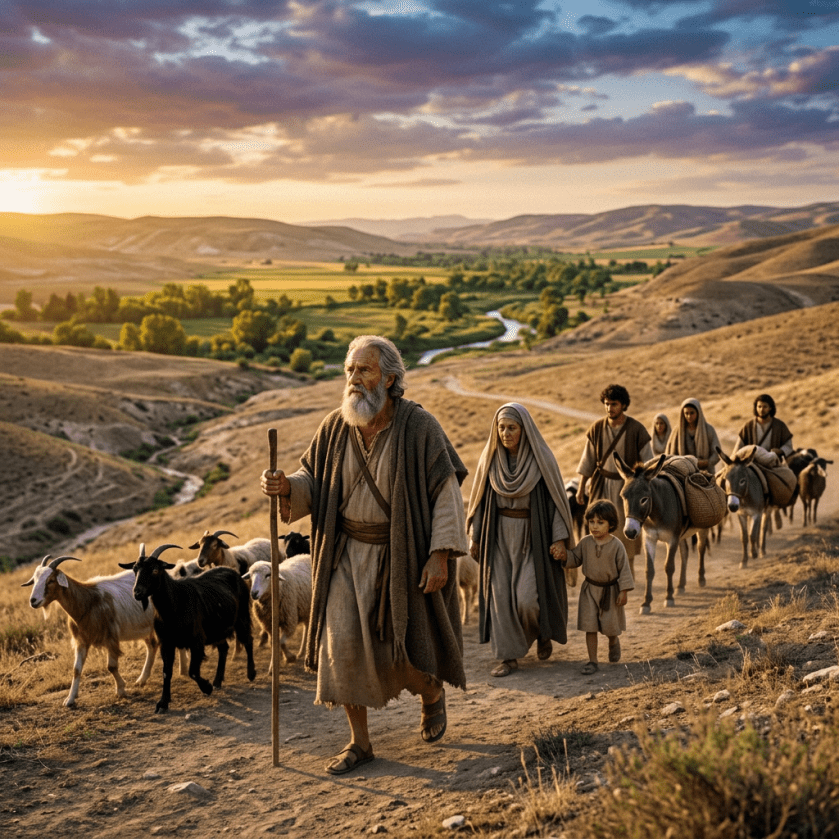
Genesis 12:1-3. 1Now the Lord said to Abram, “Go from your country and your kindred and your father’s house to the land that I will show you. 2And I will make of you a great nation, and I will bless you and make your name great, so that you will be a blessing. 3I will bless those who bless you, and him who dishonors you I will curse, and in you all the families of the earth shall be blessed.”
Genesis 12:4. So Abram went, as the Lord had told him.
Why did you choose to become a Christian? What was your motivation? For some, the choice to follow Jesus is motivated by the desire to avoid going to Hell. For others the motivation is to go to Heaven. I know for myself growing up that was often the choice that was presented: Heaven or Hell. Of course, this is a real choice, but it does beg the question if we are choosing to become Christians out of our own self-interest.
Genesis 12:4 bluntly records Abraham’s obedience, but it says nothing of his motivations. As you know, Genesis 12:1-3 lists the tremendous promises of God to Abraham: land, seed, blessing. The Promised Land, a great name and a great nation, and blessing, fabulous favor with God. So Abram went. Yes, this was an act of faith as Hebrews 11 tells us, but was it also in some way an act of selfishness? I trust God to give me everything I want, health and wealth, fame and fortune, status and satisfaction.
Was Abraham’s obedience rooted in looking out for his own interests? Is ours?
Can we be honest? This is what makes faith in God so tricky sometimes. How do we show that we love God without making it about only loving the things he can give us? Are we trusting God just so that we can receive the rewards of God? And does that make our faith manipulative? Do we love God simply for what he can do for us? And does that make our love self-serving?
To answer this, let’s consider how God defines faith in scripture – “Now faith is the assurance of things hoped for, the conviction of things not seen” (Heb. 11:1). “Things.” God has no problem in us trusting him for his things. His blessings. Truly, what is God without his promises? Who is God without his gifts? Don’t the rewards of God reveal the nature of God, thus allowing us to trust God for who he actually is? Hebrews 11:6 puts it this way:
Hebrews 11:6. And without faith it is impossible to please him, for whoever would draw near to God must believe that he exists and that he rewards those who seek him.
God wants us to seek him for the reward. He wants us to trust him for the blessing. He wants us to love him because of what he can do for us. He wants us to come to him for the rest, for the prize, for the everlasting life. This doesn’t bother God at all. Why not? Well, to answer this we must go a bit deeper into the Abraham story, all the way to Genesis 22.
Genesis 22:1-3. 1After these things God tested Abraham and said to him, “Abraham!” And he said, “Here I am.” 2He said, “Take your son, your only son Isaac, whom you love, and go to the land of Moriah, and offer him there as a burnt offering on one of the mountains of which I shall tell you.” 3So Abraham rose early in the morning, saddled his donkey, and took two of his young men with him, and his son Isaac.
For Abraham, every promise of God, every blessing, was rooted in his beloved son, Isaac. And now God is asking Abraham to sacrifice, to return if you will, this most gracious of gifts, his legacy, his honor, his reward.
The parallels between Genesis 12 and Genesis 22 are clear. In Genesis 12 God tells Abraham to go to a land. Abraham goes with Lot (more on him later). Abraham arrives in the Promised Land and builds an altar and sacrifices to God. In Genesis 22 God tells Abraham to go to a land (Moriah). Abraham goes with Isaac. And once again, Abraham builds an altar to God to sacrifice. Not a lamb, but his child of promise.
You probably know the rest of the story. God stays Abraham’s knife, spares Isaac, and provides a ram instead. So what was the point of this exercise? Abraham had to decide what his true reward would be. Isaac or God. God’s gift or God himself. And that choice would define Abraham’s faith. His life. What is the meaning of life? Is it about getting as much of God’s stuff while we can, or is it about knowing God? Loving and trusting him no matter what?
Our union with Christ calls us to a place where we never have to separate God’s reward from God himself. God’s greatest gift to us is Christ in us. His greatest blessing is the Spirit of Christ pouring the nature of Jesus into our hearts. His greatest reward is himself.
Jesus is our Promised Land – we are rooted and grounded in him.
Jesus is our great name – all that he has earned and achieved is imputed to us.
Jesus is our blessing – being known by him, loved by him, and cared for by him is its own reward.
Did you choose Jesus for all that he could do for you? That’s OK. God wants us to trust him for his promises.
But have you also found that loving and being loved by Jesus is blessing enough? That like Abraham on Mount Moriah you can let go of everything else for the sake of simply trusting him? Such faith is its own reward.
You: Do you see God as a rewarder? What makes this difficult for you?
You in Christ: Along with everything it gives us, how does our union with Christ becomes its own reward?
Christ in you: How might you come to enjoy God/Christ for who he is, not just for what he will do for you today?
Prayer: Father, give me a faith and love for you that is strengthened by your gifts but truly relies on your goodness, even when you withhold things from me, or ask me to sacrifice what I believe to be my life’s purpose. Amen.

