
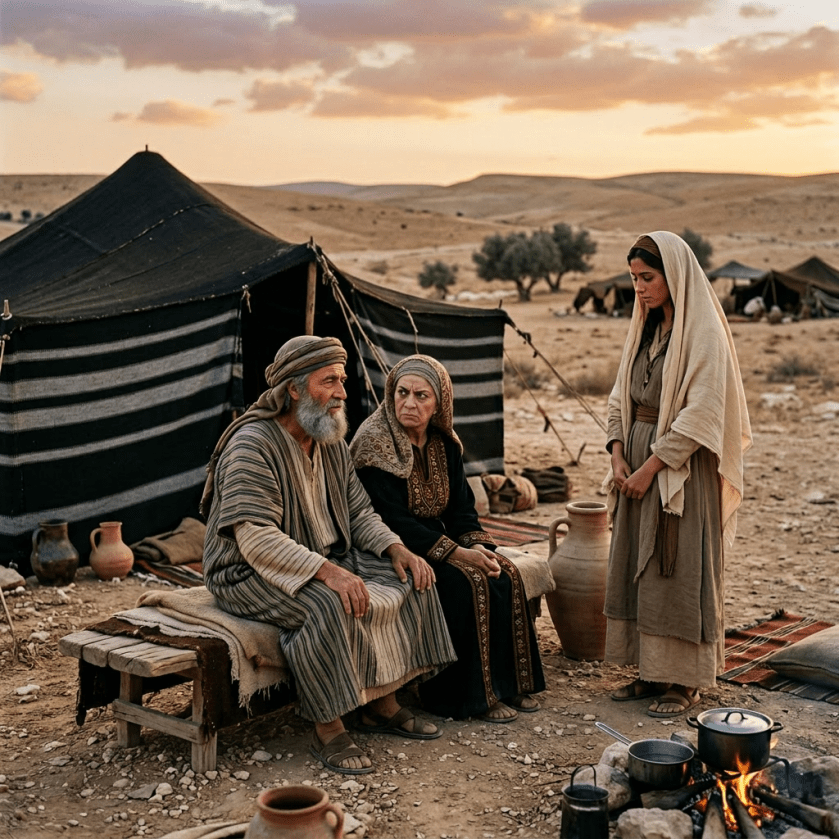
Genesis 16:1-6. 1Now Sarai, Abram’s wife, had borne him no children. She had a female Egyptian servant whose name was Hagar. 2And Sarai said to Abram, “Behold now, the Lord has prevented me from bearing children. Go in to my servant; it may be that I shall obtain children by her.” And Abram listened to the voice of Sarai. 3So, after Abram had lived ten years in the land of Canaan, Sarai, Abram’s wife, took Hagar the Egyptian, her servant, and gave her to Abram her husband as a wife. 4And he went in to Hagar, and she conceived. And when she saw that she had conceived, she looked with contempt on her mistress. 5And Sarai said to Abram, “May the wrong done to me be on you! I gave my servant to your embrace, and when she saw that she had conceived, she looked on me with contempt. May the Lord judge between you and me!” 6But Abram said to Sarai, “Behold, your servant is in your power; do to her as you please.” Then Sarai dealt harshly with her, and she fled from her.
Genesis 16 flashes us forward another ten years. It’s now been a decade since God cut the covenant with Abraham, promising him a son of natural birth. And now, ten years later, from the heights of great faith, Abraham will come crashing back down to Earth. Like Adam and Eve, Abraham and Sarah will find themselves using their own knowledge of good and evil to make a decision in the place of God. And just as in Eden, the shame, the blaming, the pride, will all lead to disastrous results – Then Sarai dealt harshly with her, and she fled from her.
The conflict between Sarah and Hagar is the overflow of the conflict within Sarah’s own heart. The more God adds clarity to his promises to Abraham, the more it becomes clear to Sarah that she is the problem. Sarah’s suggestion to her husband is both reasonable and culturally acceptable – Go in to my servant; it may be that I shall obtain children by her. Clearly any offspring from Hagar will be Sarah’s, thus relieving her of her shame (or so she thinks). Sarah’s reason and her faith are in conflict in her heart and mind, and her reason won. Abraham too seems to have lost his patience with God. Granted, ten years is a long time to wait, assumedly in silence, and so, like Adam in the garden, he capitulates to the voice of Sarah his wife, rather than lead Sarah to the Tree of Life – trust in God.
And just like in Genesis 3, all relational hell breaks loose. Sarah aggressively blames Abraham. Hagar passive-aggressively lords it over Sarah, Abraham passively releases himself of all blame, and Sarah aggressively takes all her shame and insecurity out on Hagar, afflicting the Egyptian just as one day the Egyptians will afflict the children of Sarah.
In his letter to the Galatians, Paul uses this sad story as an example of what self-effort in our salvation looks like. When self-righteous works trump faith you get an Ishmael, not an Isaac.
Galatians 4:21-23. 21Tell me, you who desire to be under the law, do you not listen to the law? 22For it is written that Abraham had two sons, one by a slave woman and one by a free woman. 23But the son of the slave was born according to the flesh, while the son of the free woman was born through promise.
Two sons. One born of flesh. The other born of promise.
Paul goes on to call the Abraham, Sarah, and Hagar story an allegory. Works of the law v. faith in Christ. Genesis 16 is not just a disastrous story for Abraham and Sarah, it is our story as well. Each time we return to the works of the law in order to obtain what God has freely promised to us in Christ, we are risking not only our faith, but also our love. There’s not much love in Genesis 16:1-6. As James 4 so perceptively describes when diagnosing conflict, there’s covetousness, inordinate desire, quarreling, anger, and hatred. Why? James continues, “You have not because you ask not.”
How long had it been since Abraham built an altar, or cried out to God? And where is Sarah’s faith, her questioning, her doubting? What form does it take? Soon Sarah will have a God encounter and she will literally laugh at him. Why did this family, enshrined in Hebrews 11 as heroes of the faith, experience such relational collapse? Why do we? Had they stopped seeking God? Stopped asking? Have you? Did they, as James also says, only ask to “spend it on their own pleasure?”
And here’s what makes this story such a warning: Abraham’s “fleshly” (as Paul says) response was not like his actions in Egypt, sheer self-preservation and completely thoughtless toward Sarah. Here, with Hagar, his actions seem to be considerate of Sarah (he’s doing what she asks), and even faithful to God (God never said my son would come through Sarah, and Hagar was part of God’s reward to me when I left Egypt, so…). This is the real danger – the flesh often looks like faith, like obedience.
This is why, in Galatians, Paul calls law-keeping fleshly. How can obeying God’s law be sinful? Trust me it can be. When it is obedience from shameful self-abasement or from prideful self-promotion. So when Hagar conceives the masks come off, all the true motivations are revealed, and none of them are faithful (anger, blaming, affliction, passivity, boasting). This is always what living under the law produces – relational upheaval. Pride. Comparison. Victimhood. Contempt. Affliction. And finally, fleeing.
As we’ll see in the conclusion of the Hagar saga, God won’t let us just run away. He will always pursue us, find us, and see us. This is the promise of our union with Christ, that what our failed rationality and law keeping threatens, Christ Jesus restores and uses for his glory and our good.
You: Can you identify where you are living from flesh and not faith?
You in Christ: How does being in Christ remove the need for any self-effort?
Christ in you: Where is faith required of you today? How does the Christ in you want to respond in faith over flesh?
Prayer: Father, most of what I do is from my own best efforts and my own rational “good” ideas. I can see how so often this leads to broken relationships too. Help me to not run ahead of you and to stop and renew my trust in the promises of Christ for me. Amen.

