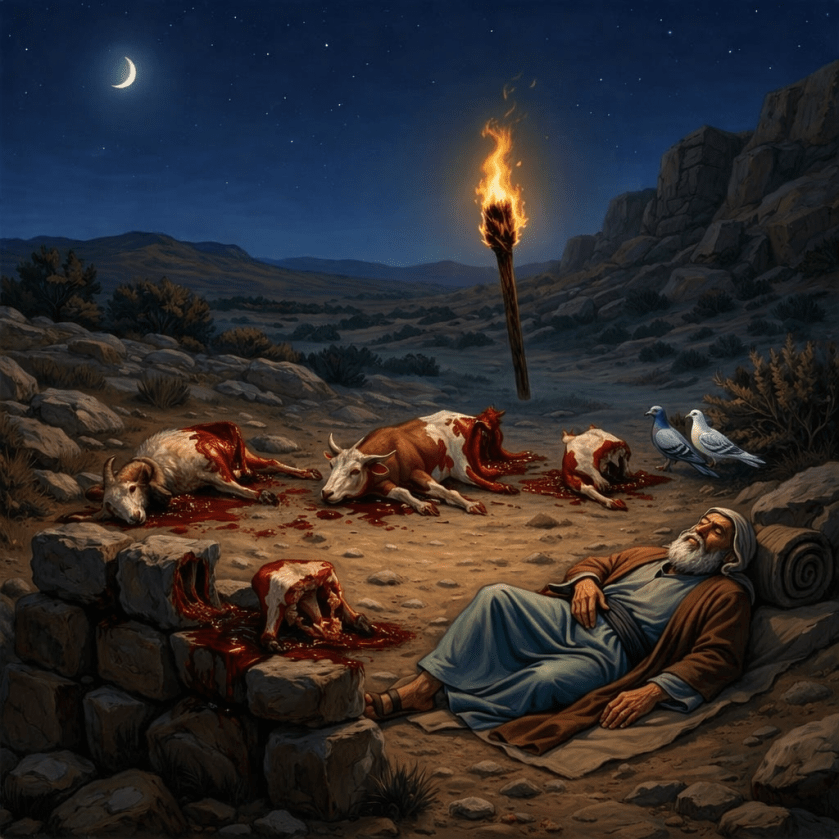
Genesis 15:7-21. 7And [God] said to [Abraham], “I am the Lord who brought you out from Ur of the Chaldeans to give you this land to possess.” 8But he said, “O Lord God, how am I to know that I shall possess it?” 9He said to him, “Bring me a heifer three years old, a female goat three years old, a ram three years old, a turtledove, and a young pigeon.” 10And he brought him all these, cut them in half, and laid each half over against the other. But he did not cut the birds in half. 11And when birds of prey came down on the carcasses, Abram drove them away. 12As the sun was going down, a deep sleep fell on Abram. And behold, dreadful and great darkness fell upon him. 13Then the Lord said to Abram, “Know for certain that your offspring will be sojourners in a land that is not theirs and will be servants there, and they will be afflicted for four hundred years. 14But I will bring judgment on the nation that they serve, and afterward they shall come out with great possessions. 15As for you, you shall go to your fathers in peace; you shall be buried in a good old age. 16And they shall come back here in the fourth generation, for the iniquity of the Amorites is not yet complete.” 17When the sun had gone down and it was dark, behold, a smoking fire pot and a flaming torch passed between these pieces. 18On that day the Lord made a covenant with Abram, saying, “To your offspring I give this land, from the river of Egypt to the great river, the river Euphrates, 19the land of the Kenites, the Kenizzites, the Kadmonites, 20the Hittites, the Perizzites, the Rephaim, 21the Amorites, the Canaanites, the Girgashites and the Jebusites.”
Do you remember as a kid making a promise you would say “cross my heart hope to die, stick a needle in my eye?” That whole “hope to die” part always seemed a bit extreme didn’t it? But in the Bible, when God makes promises to people the penalty of death for breaking the promise was always on the table.
What we are witnessing in Genesis 15 is called a covenant. In ancient times, a covenant was an agreement between two parties that created a reciprocal relationship of promise keeping that was also legally binding – breakable only by death (cross my heart hope to die). This relationship was graphically illustrated in the covenant ceremonies of the Ancient Near East, a ceremony God and Abraham went through in Genesis 15.
When Abraham was full of fear and doubts about his future, when he needed answers for his questions, God formalized his promises to Abraham with this traditional (and bloody) covenant ceremony. It was called “cutting the covenant,” and it was quite intense. Animals were cut in pieces and spread out creating a gruesome aisle of carcasses that both parties would walk through as they made their promises to each other. It was as if to say, “May I be cut in half like these animals if I do not keep my promise.”
But this covenant cutting between God and Abraham looked a bit different than usual. The Bible describes a deep darkness that came over Abraham like a trance. Then God, appearing as a smoking fire pot and a flaming torch, passed through the carcasses of the animals alone, while Abraham did well…nothing. Only God passed through the pieces of animal flesh.
Genesis 15 makes it vividly clear that God’s covenant with Abraham is unconditional, dependent only upon God himself, not Abraham’s obedience or even his level of faith. Abraham literally cannot contribute anything to the promises of God here. Land from the Nile to the Euphrates? He’s just a tent dwelling sojourner. Yes, he has 314 trained commandos living with him, but he is still no match for the big boys of Palestine. The Hittites, the Amorites, the Perezites, and all the other “ites.” It will be another 400 years before God even begins to deal with them, and Abraham will be long dead and buried. In addition, this promise of offspring grows ever more elusive too. Abraham can’t even control his own family planning (or can he? – chapter 16), not with a barren and now elderly wife.
The promises, dedications, commitments that people make to God are never kept and therefore pointless, but promises made by God to us are always kept by our unchanging, faithful God. That’s why God walked between the bloody pieces twice, as smoke and fire. You see, God was not just making promises TO Abraham; he was making promises AS Abraham. God was promising to uphold both sides of this covenant. God is righteous and God will be Abraham’s righteousness (Gen. 15:6). God will die if he breaks the covenant (which won’t happen), but God will also die if Abraham or his descendants break the covenant (which will happen).
God is risking his life for this relationship. He “crossed his heart and hoped to die.” For us. Why would God do that? Hasn’t Genesis proved that it is risky for God to even deal with us at all, much less make a covenant with us? A covenant that risks his own life for us? That’s beyond insane, isn’t it?
Not if you’re in love.
That same love will cause God to cut another covenant with mankind 2000 years after Abraham. On another day of deep darkness Jesus was torn in two for us. His body was broken. His blood was spilled. On that day, Jesus Christ, the God-man, passed through death as we watched helplessly in the darkness, unable to contribute anything to our own salvation. But like the divine smoke and fire walking between the slaughtered animals, Jesus passed all the way through to the other side. And as Christ fulfilled the covenant with Abraham, he is now able to be the mediator of a New Covenant. A new unconditional covenant. A covenant of grace that God will keep himself. Jesus our God will keep all the promises of God, and Jesus our substitute will keep all the obligations of man. Union with Christ means that we now live in the glory of God’s New Covenant with us, where every promise finds its “Yes” in Christ, and every command is able to be obeyed through Christ in us.
When you doubt God’s love, look at the cross where the covenant was cut for you. When you break the covenant, remember Jesus was broken for you. When the darkness is overwhelming, remember that Christ made a way through it. And as you remember the covenant it will empower you to live for him. A living sacrifice, not torn in half, but united to Christ.
You: Where do you find yourself doubting the love of God lately?
You in Christ: In Christ, you have every covenant promise, all of Jesus’ own blessings. How does this truth relieve your doubts and fears?
Christ in you: How can knowing that covenant obedience has already been accomplished make obeying God a delight today, rather than just a duty?
Prayer: Father, your New Covenant promises are so special to me and so empowering. Cause me to remember that I cannot let you down because I am in Christ. Amen.

