
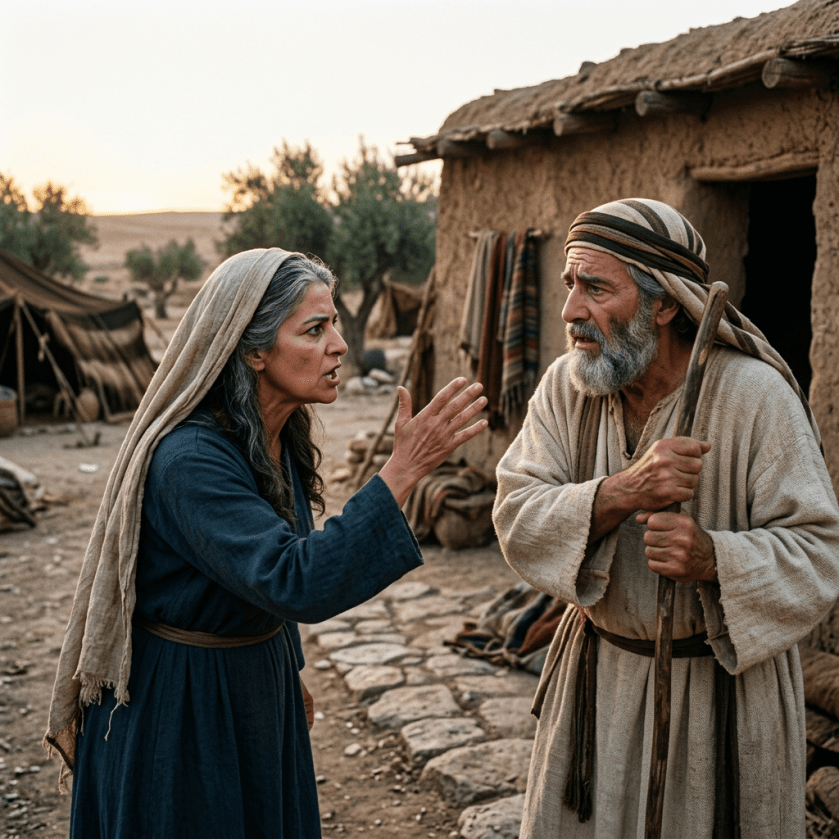
Genesis 16:1-6. 1Now Sarai, Abram’s wife, had borne him no children. She had a female Egyptian servant whose name was Hagar. 2And Sarai said to Abram, “Behold now, the Lord has prevented me from bearing children. Go in to my servant; it may be that I shall obtain children by her.” And Abram listened to the voice of Sarai. 3So, after Abram had lived ten years in the land of Canaan, Sarai, Abram’s wife, took Hagar the Egyptian, her servant, and gave her to Abram her husband as a wife. 4And he went in to Hagar, and she conceived. And when she saw that she had conceived, she looked with contempt on her mistress. 5And Sarai said to Abram, “May the wrong done to me be on you! I gave my servant to your embrace, and when she saw that she had conceived, she looked on me with contempt. May the Lord judge between you and me!” 6But Abram said to Sarai, “Behold, your servant is in your power; do to her as you please.” Then Sarai dealt harshly with her, and she fled from her.
I want to spend another day in these first six verses of Genesis 16, this time focusing on Sarah, Abraham’s wife.
The temptation in reading this story may be to simply see Sarah as being an irrational woman who has lost control of her emotions. It was her idea for Abraham to marry and sleep with Hagar, and then when he does what she suggests, and a child is conceived, suddenly she loses her mind and begins to blame Abraham and afflict poor Hagar. Sarah’s behavior seems to make no sense.
The great medieval Jewish scholar, Rashi, asks the same question we might be asking – why is Sarah so mad at Abraham? Rashi suggests that her anger is ten years in the making, going back to Abraham’s conversation with God in chapter 15. Abraham asked God, “What will you give me?” God then promised Abraham his own biological son. But why wasn’t Sarah part of this conversation? Why didn’t Abraham ask, “What will you give US?” Why didn’t he ask if Sarah was going to be a mother? Would God have told him? For ten years Sarah has felt left out of God’s promise. God promised Abraham children, but not her.
You can almost hear the Enemy asking Sarah the same question he asked Eve in the garden – did God really say? Maybe Sarah started out trusting that she too would be part of God’s promise, but over ten years of waiting how deep has Satan gotten into her head? Is this why Sarah says, the Lord has prevented me from bearing children.
The rest of the story also mimics Genesis 3. Eve had the fruit, Sarah has a female servant. Eve gave the fruit to Adam. Sarah gave her servant to Abraham. Adam took the fruit. Abraham took Hagar as a wife.
Sarah’s response in Genesis 16 is not irrational, nor should it be unexpected. It has been months and even years in the making. When Sarah begins to oppress Hagar it is not because she is cruel or out of control, quite the contrary. Sarah’s response is her attempt to regain control over her life and legacy. How? By regaining control over Hagar, the servant who, since becoming pregnant, refuses to serve her mistress. Something that clearly Abraham had no interest in making her do.
Make no mistake, Sarah’s oppression of Hagar is wrong. It is cruel. But we can also see why Sarah felt like she had to do it. Why she needed to reassert her control over her life. It should not be surprising at all. In fact, this response by Sarah is part of the curse that God predicted back in Genesis 3:
Genesis 3:16. To the woman he said, “I will surely multiply your pain in childbearing; in pain you shall bring forth children. Your desire shall be for your husband, and he shall rule over you.”
Like sin’s desire to control Cain in Genesis 4, Eve’s desire was to control her husband. To rule over him. But he shall rule over her. And the curse of control has been destroying marriages ever since. Eve’s and Sarah’s desire for control are not born out of a ruthless desire to destroy their men. The desire to control comes from a desire to be a partner in the relationship, an ezer kenegdo (a helper fit for him) not an afterthought. It comes from a desire to share in the blessing of God and to be desired by your husband. Not forgotten when he’s discussing family planning with God Almighty.
The word desire used in Genesis 3 is only used three times in the Hebrew Old Testament. Genesis 3 of course, Genesis 4, sin’s desire is for Cain, and in Song of Solomon where the bride declares that her husband’s desire is for her – “I am my beloved’s, and his desire is for me” (Song 7:10). You see, how does a person let go of their desire to control others? By knowing that they are desired.
Most of us think that the good life comes when we control more of our life than we don’t. Sarah believed this. She was only alright if she was in control of her own future, her family’s future. Her child, the maidservant’s child, her maidservant, her husband. If she could control each of these she would be OK. She would be part of the plan. Or, she could have radically embraced God’s love over her own control. She could have asked God for her own answer – Lord, what will you give me?
How can we give up our desire to control our life, our legacy, and those we love? Only when we know what God has given to us – his only begotten son, Jesus. Only when we know that Jesus desired us so much that he gave his life, his legacy, and his love to us eternally without fail.
God cannot be controlled, but he can be received. Our union with Christ does not place us in control, but it does place us in a position to ask and receive. Lord, what will you give me today so that I don’t need to control my own life? Your love? Your grace? Your new morning mercies? Your Beloved Son. Period.
You: Where can you see yourself trying to control your life? Your legacy? Your loved ones?
You in Christ: Where do you feel left out of God’s plan? What question does your union with Christ allow you to ask of God? How does your union with Christ already offer answers to the questions of your heart?
Christ in you: How does the desire of Christ for you relieve you of your desire to control your own life?
Prayer: Father, I confess my need to control things in my life. But when I know that your desire is for me, I know I can release my desire to control the outcomes of my life. Amen.

