
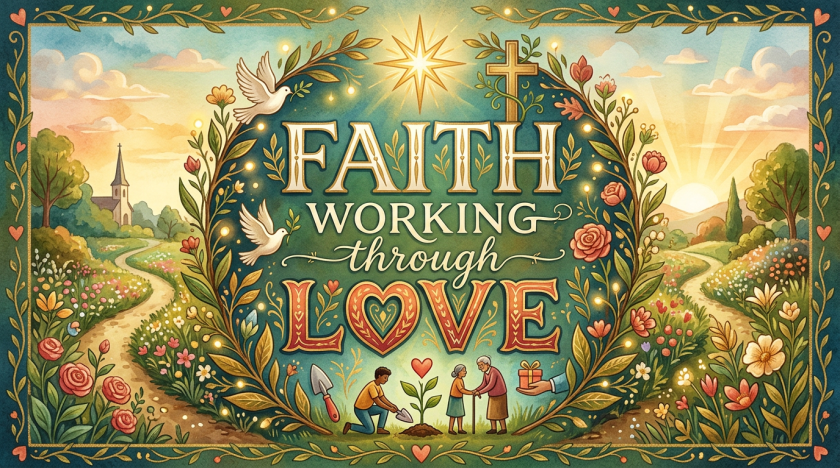
Galatians 5:5-6. 5For through the Spirit, by faith, we ourselves eagerly wait for the hope of righteousness. 6For in Christ Jesus neither circumcision nor uncircumcision counts for anything, but only faith working through love.
For Paul, love will always be the highest of all virtues. “Above all put on love,” he tells the Colossians (Colossians 3:14). And of course, we all know 1 Corinthians 13—“without love I am nothing.” We might say that “faith working through love” (Galatians 5:6) is the summation of the Christian life.
God is love, so to truly love is to live from God’s own divine nature. Yet love is the end result of the Christian life, not the starting line. Faith is the beginning. Remember what Paul has already said in Galatians 2:20—“I live by faith.” Too many Christians make the mistake of trying to begin and end with their own love, rather than beginning with faith and letting that faith produce God’s love in them.
Faith is trust in who God says he is and in what he says he will do. Here in Galatians 5:5, our faith rests in our hope—the “hope of righteousness.” This is the promise of God rooted in the character of God: our righteous God has made us, and will make us, righteous.
As Christians, we must constantly check to see that our faith is not in our love for God, but in God’s love for us. We must test that our faith is never in what we do, but in who we are: those who have been crucified with Christ. In a very real sense, the growing Christian must move beyond the “love motive” to the “faith motive.”
Maybe when you first became a believer, you were deeply motivated by love and gratitude toward God for the beautiful saving work he had done in your life. Amen! Yet ever since then, you have struggled to maintain that same emotional motivation, that same level of gratitude, and those same feelings of commitment.
Christian, you are settling for the good over the best. The love motivation is good, but the faith motivation is best. “I live by faith.” We don’t live and die BY our love; we live by faith in the power of Christ’s life in us. And this faith produces love—“faith working through love.”
Our freedom in Christ is freedom from having to manufacture our own affection for God. Instead, faith frees us to trust in Jesus alone. And when we trust him, the Holy Spirit produces genuine love within us—the very love of God himself.
You: Are you currently living from the “love motivation” (trying to muster up affection) or the “faith motivation” (trusting God’s work)?
You in Christ: Are you resting in your identity in Christ? How can you tell?
Christ in you: Why must it be Christ producing love through us, rather than us trying to produce it ourselves?
Pray: Father, I do love you, but even more, I want to trust you. Keep teaching me how to return to my hope in Christ and rest in my identity in you. Amen.

