
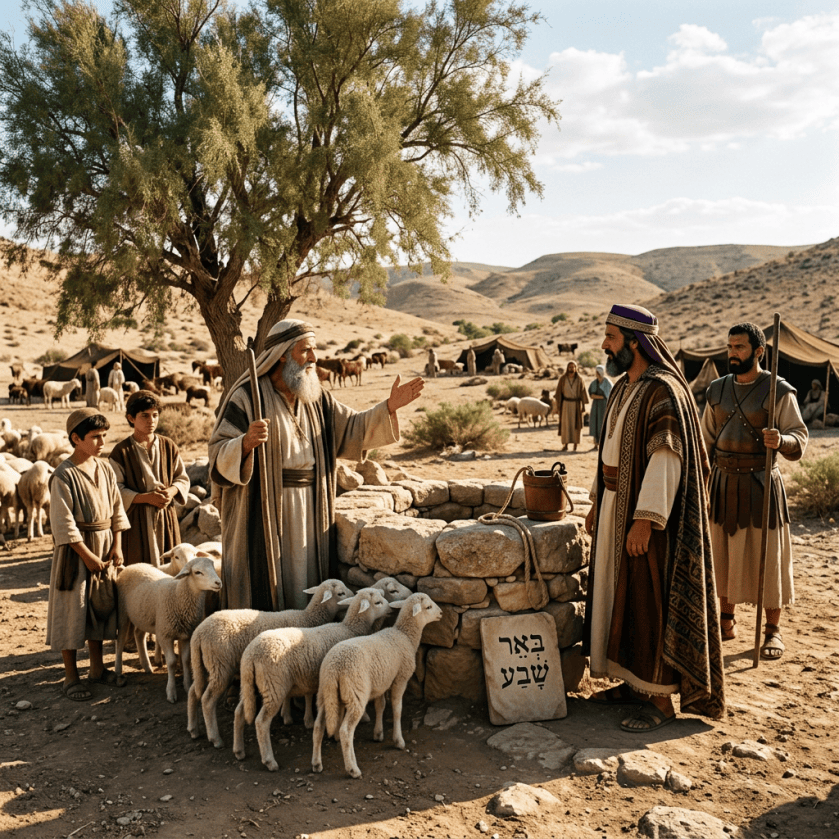
Genesis 2122-34. 22At that time Abimelech and Phicol the commander of his army said to Abraham, “God is with you in all that you do. 23Now therefore swear to me here by God that you will not deal falsely with me or with my descendants or with my posterity, but as I have dealt kindly with you, so you will deal with me and with the land where you have sojourned.” 24And Abraham said, “I will swear.” 25When Abraham reproved Abimelech about a well of water that Abimelech’s servants had seized, 26Abimelech said, “I do not know who has done this thing; you did not tell me, and I have not heard of it until today.” 27So Abraham took sheep and oxen and gave them to Abimelech, and the two men made a covenant. 28Abraham set seven ewe lambs of the flock apart. 29And Abimelech said to Abraham, “What is the meaning of these seven ewe lambs that you have set apart?” 30He said, “These seven ewe lambs you will take from my hand, that this may be a witness for me that I dug this well.” 31Therefore that place was called Beersheba, because there both of them swore an oath. 32So they made a covenant at Beersheba. Then Abimelech and Phicol the commander of his army rose up and returned to the land of the Philistines. 33Abraham planted a tamarisk tree in Beersheba and called there on the name of the Lord, the Everlasting God. 34And Abraham sojourned many days in the land of the Philistines.
First of all, can we admit that this story seems very out of place. The high drama of the birth of Isaac, the expulsion of Ishmael, and the coming binding of Isaac (Ch. 22) are broken up by this story of Abraham and Abimelech and their conflict over a well. So why is this story here? Why did Moses insert this scene into his narrative at all? What was Israel to learn from this and what are we to learn? This story reveals something about Abraham and his heart. His desire to live at peace with all men, and the peace that is brought about by the birth of the promised child of peace, Isaac.
When God called Abraham out of Ur, he made covenant promises to him, including the promise that Abraham would be a blessing to all nations. Well, that hasn’t always been the case so far, has it? Including Abraham’s past interaction with Abimelech. You recall Abraham’s deception with Abimelech concerning Sarah, a deception that almost got Abimelech killed by God (Ch 20). It’s no wonder that Abimelech comes to Abraham asking for honesty and integrity from Abraham – therefore swear to me here by God that you will not deal falsely with me or with my descendants or with my posterity, but as I have dealt kindly with you, so you will deal with me and with the land where you have sojourned.
Abimelech gets it. He has been deeply impacted by Abraham. He recognizes that God is with Abraham, prospering him in everything. Abimelech is able to see past Abraham to God himself. Abraham has been a liar and can’t be fully trusted, but his God? His God is obviously powerful enough to make a 90-year-old woman have a child. A child whose descendants will be in this land for centuries to come. So what does Abimelech do? He seeks peace. Peace with Abraham and peace with God.
Could this also be true for Israel as they enter the Promised Land? When the nations see that God is with them in a powerful way, might they too come seeking peace with Israel and Israel’s God? And could this also be true of us today? When your co-workers, neighbors, and relatives see that God is with you, not because you are perfect (Abraham was far from perfect), but because you are blessed with his grace and love, might they too come seeking peace with your God, the Prince of Peace? Or, as Peter says, when our conduct is honorable and our good deeds are flowing might that draw others to Christ?
1 Peter 2:11-12. 11Beloved, I urge you as sojourners and exiles to abstain from the passions of the flesh, which wage war against your soul. 12Keep your conduct among the Gentiles honorable, so that when they speak against you as evildoers, they may see your good deeds and glorify God on the day of visitation.
Abraham’s conduct with Abimelech in this encounter was definitely honorable (far more so than it was back in chapter 20). In fact, Abraham’s conduct foreshadows Jesus’ teaching in the Sermon on the Mount. A well that Abraham had dug was seized by the men of Abimelech. Abimelech denies any knowledge of this (hardly likely). What would you do? Fight to get it back? Take him to court? Hold a grudge? Smear him on social media? What does Abraham do? He offers a covenant of peace. Abraham, the one who has been offended by Abimelech, turns the other cheek and instead he cuts a covenant with Abimelech. Just like God did with Abraham in Genesis 15, Abraham will offer his own sheep and oxen as the bloody pieces of the covenant path to peace.
Abraham offers peace to Abimelech and Abimelech gives back to Abraham what was already his. Sound familiar? Jesus Christ offers us his covenant of peace in exchange for what is already his – our lives. God offers true and lasting peace with him but he also demands his rights, his authority over all things. Including us. God deals kindly with us in Christ, and we deal wholeheartedly submissive to Christ in our lives. That’s the deal, the covenant, the Christian life.
And when God’s people live from both his peace and his authority, that is when the world will be drawn to Christ out of sheer desperation to experience the presence of God that they see with us – God is with you in all that you do.
To live is Christ is to trust the power of his presence in our lives, the presence of real peace with God. A peace that both demands and empowers honesty and commitment to him, our Everlasting God. May we now live as ambassadors of that peace as we sojourn among the “Philistines” of this world, ever seeking to point them to the peace of Christ through our honorable and redemptive conduct.
You: Ae you able to live at peace with all people? What makes this difficult for you?
You in Christ: How does our peace with God in Christ allow us to seek peace with the world around us?
Christ in you: How might your conduct need to more humbly reflect the peace and authority of Jesus?
Prayer: Father, you are the Everlasting God. El Olam. Your peace from Christ in my heart is eternal and powerful enough to let me turn the cheek so as to reflect your presence with me. But I need your help to live this way. Let your peace overwhelm my heart today. Amen.

