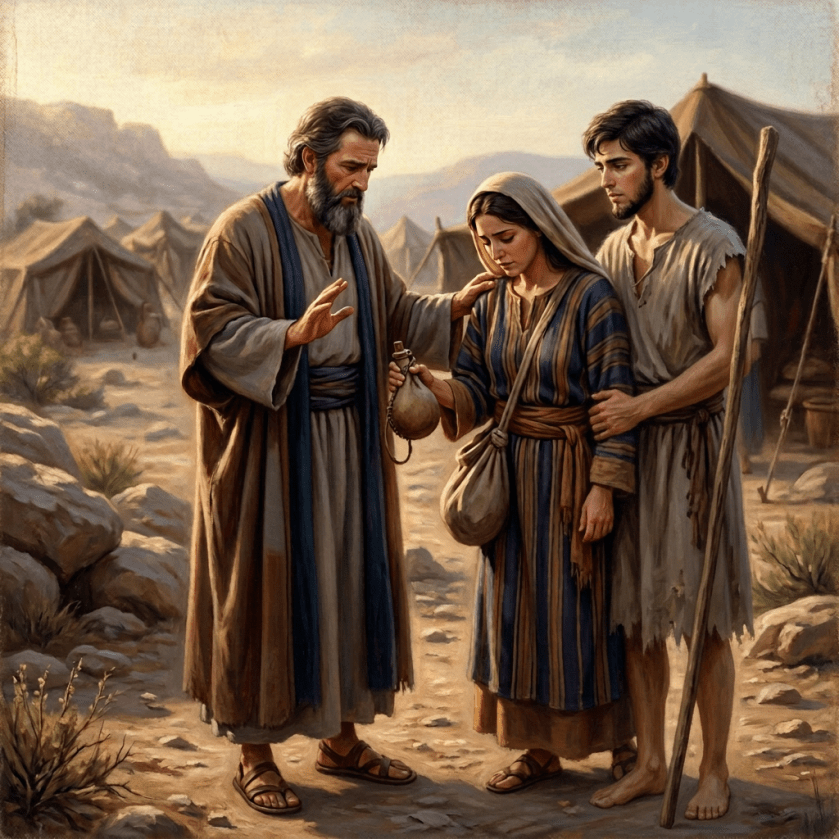
Genesis 21:8-14. 8And the child grew and was weaned. And Abraham made a great feast on the day that Isaac was weaned. 9But Sarah saw the son of Hagar the Egyptian, whom she had borne to Abraham, laughing. 10So she said to Abraham, “Cast out this slave woman with her son, for the son of this slave woman shall not be heir with my son Isaac.” 11And the thing was very displeasing to Abraham on account of his son. 12But God said to Abraham, “Be not displeased because of the boy and because of your slave woman. Whatever Sarah says to you, do as she tells you, for through Isaac shall your offspring be named. 13And I will make a nation of the son of the slave woman also, because he is your offspring.” 14So Abraham rose early in the morning and took bread and a skin of water and gave it to Hagar, putting it on her shoulder, along with the child, and sent her away. And she departed and wandered in the wilderness of Beersheba.
Well that didn’t last long. The text of Genesis 21 is giving us whiplash as we spin from a day of great rejoicing and laughter at the birth of Isaac to a day of jealousy and mocking at the weaning of Isaac.
Hagar and Ishmael are reintroduced into the narrative, a reminder that the results of our sin will follow us for years to come. Ishmael is now a young man, likely 16-17 years old. The drama between Hagar and Sarah in Genesis 16 is being repeated by their offspring. More than a decade and a half earlier Hagar’s attempt to position herself above Sarah led to her abuse and flight in the wilderness. Ishmael is repeating this generational sin by laughing at, mocking, the toddler who is his master.
Sarah’s response can seem like petty jealousy, overly dramatic on the surface. But the truth rarely lies on the surface. In Galatians 4, Paul tells us that Ishmael “persecuted” Isaac; the seed born of the flesh attempting to destroy the seed born of the Spirit. Is another Cain and Abel scenario brewing? It appears so. How much of this did Sarah understand from a spiritual level? Well, let’s presume the best.
Make no mistake, God is absolutely committed to his covenant plan of grace, and he will not let anything stand in its way. Sarah seems to understand this even better than Abraham. When she says the son of this slave woman shall not be heir with my son Isaac, she is using a word that was used back in chapter 15 – heir. Abraham’s heir won’t be Lot; he needs to be let go. It won’t be Eliezer, you need to forget that idea, Abraham. And it won’t be Ishmael; he too needs to depart. Sarah is quoting God to her husband. This makes Abraham angry (very displeasing). But if Abraham can’t let go of Ishmael and trust God, how will he ever let go of Isaac (yes, I’m foreshadowing)?
Listen, this story isn’t only here to remind us of the dangers of jealousy and pride, it is here to remind us of the great cosmic battle taking place in human history. The great separation of humanity. Flesh v Spirit. Works v faith. Law v Gospel. I’m not stretching the text beyond its original meaning. God himself says to Abraham, for through Isaac shall your offspring be named. Then God assures Abraham that Ishmael too will be a great nation. So why isn’t Ishmael considered Abraham’s offspring? Because only Isaac is the offspring of faith, and Abraham is meant to be a great nation of faith, its greatness being the doing of righteousness and justice.
Genesis 18:18-19. 18Abraham shall surely become a great and mighty nation, and all the nations of the earth shall be blessed in him? 19For I have chosen him, that he may command his children and his household after him to keep the way of the Lord by doing righteousness and justice, so that the Lord may bring to Abraham what he has promised him.”
The covenant of God, the gospel of God, the love of God will always first separate before it unites. Ishmael will need to be separated from the covenant community because he didn’t trust in the coming of God’s Messiah through his little brother (like Cain, Esau, Joseph’s brothers). In the same way, all that reject Christ will be separated from God’s covenant community, the church. Isn’t this what Simeon predicted at the birth of Jesus – “he is appointed for the fall and rising of many in Israel, and a sign that is opposed,” he said (Lk. 2:34).
Not only will Jesus separate humanity externally, but he separates us each internally as well. Because of our union with Christ there is a war raging inside us all, a battle of the flesh and the Spirit. As soon as you were born again you were thrust into a war zone that divides you, soul and spirit. Walking in Christ means constant fighting with the fleshly desires to live from law keeping, earning, performance, and perfectionism. Sadly, too many Christians see this intense struggle as a sign of spiritual death. But dead people don’t fight in wars, do they? Living people do. Only those who are truly alive unto God in Christ will be aware of the intensity of the war within.
And often this war will demand banishment. Like sending Ishmael into the wilderness, we too need to be willing to send our fleshly desires off into the desert. Usually these desires are not wrong in and of themselves. Abraham’s desire to care for Hagar and Ishmael was not instinctively wrong. But this desire would stand in the way of an even greater desire. The desire for God himself and the desire for his plan to unfold by divine grace not fleshly works.
To live is Christ means a battling commitment to the way of grace. Which means that to live is Christ may bring with it painful separations. Separations from our own sin within, and separation from those who would laugh at the gospel without.
You: Can you identify where you are being separated internally – flesh v Spirit?
You in Christ: Why does our union with Christ sometimes require us to separate from other people?
Christ in you: Where do you see the need to separate from something/someone in order for God’s work of grace to continue in your life?
Prayer: Father, I know there are “Ishmael’s” in my life that I need to send away from my heart. Things that mock your grace and promote my own self-righteousness. Keep me diligent in fighting this battle that rages for my heart. Amen.
 To Live is Christ