
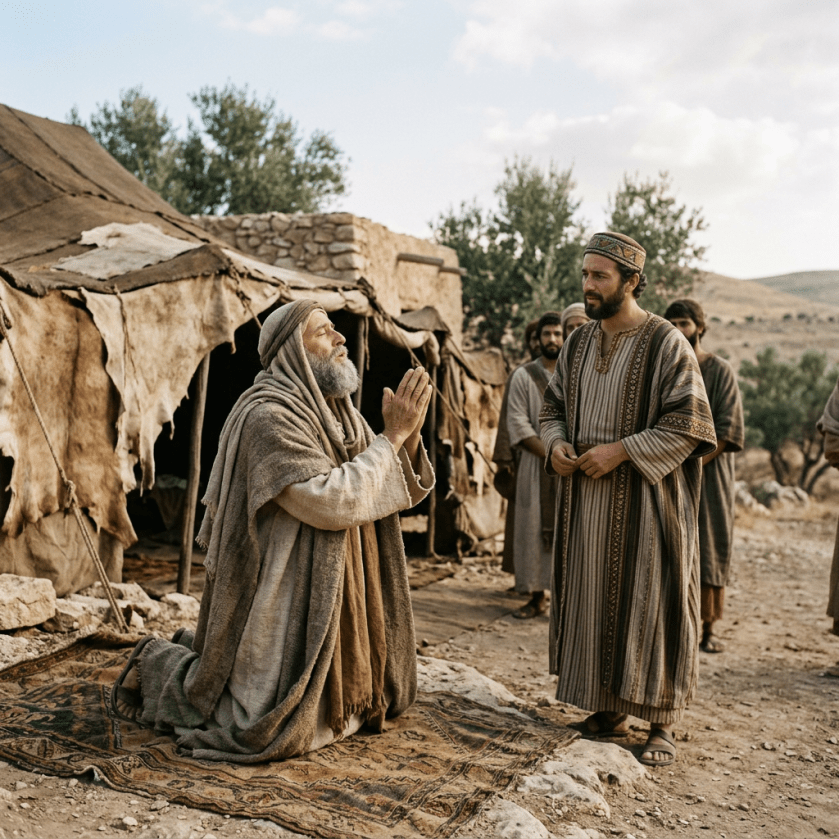
Genesis 20:14-18. 14Then Abimelech took sheep and oxen, and male servants and female servants, and gave them to Abraham, and returned Sarah his wife to him. 15And Abimelech said, “Behold, my land is before you; dwell where it pleases you.” 16To Sarah he said, “Behold, I have given your brother a thousand pieces of silver. It is a sign of your innocence in the eyes of all who are with you, and before everyone you are vindicated.” 17Then Abraham prayed to God, and God healed Abimelech, and also healed his wife and female slaves so that they bore children. 18For the Lord had closed all the wombs of the house of Abimelech because of Sarah, Abraham’s wife.
We first saw Abraham take on the priestly role of intercessory prayer in chapter 18. Prophet Abraham’s intercession for Sodom made sense. Sodom definitely needed it, and Abraham clearly did occupy the moral high ground. But not here. If anyone should be interceding shouldn’t it be Abimelech for Abraham? This is what makes this last section of Genesis 20 so surprising. It feels so backwards, so upside down. Why does Abraham get to intercede for Abimelech? After such fear and doubt shouldn’t Abraham at least be on priestly probation? Should God even listen to this selfish liar?
I remember hearing a sermon from Pastor David Platt years ago where he proposed this type of scenario/question: Imagine there are two Christians. The first one spent all night looking at pornography. He overslept the next morning, skipped his daily devotions, failed to pray, and pretty much had a grumpy attitude at work all day. The Second Christian went to his small group the night before, got up early to read the Bible and pray, and was kind and helpful at work. Both Christians are riding the bus home from work and are seated next to unbeliever who is interested in spiritual things. Both Christians pray and ask God for his help. Which Christian’s prayer will God hear? Which Christian will God help? Christian #1 or Christian #2? Then David Platt said something like, “If your answer is Christian #2 will be heard, but not Christian #1, then you don’t understand the gospel.
And if you think that Abraham has no right to intercede for Abimelech because of his sin in Gerar, then you don’t understand the grace of God. And if you think that Abimelech should be the one interceding because he was morally upright (to some degree), then again, you don’t understand the gospel.
Abimelech is not right with God simply because he feared God or was penitent. And Abraham is not outside God’s favor because he stumbled hard and sinned. When we think this, it is because we have forgotten that God operates from a grace-faith paradigm, not a good works paradigm.
Yes, it is shocking that God tells Abimelech to have Abraham pray for him (20:7). The same man that lied to you, endangered you, assumed the worst about you, and violated a hundred hospitality laws, should pray for me!? You must be joking, God.
Nope. Not joking.
The prayer that Abraham prays restores Abimelech and it reopens the wombs of the women of Gerar that God had closed. The prayer of faith combined with Abimelech’s repentance produced life in Gerar. Abimelech needed the man of God, God’s ambassador, to bring salvation to him, his family, and his nation. And in spite of our constant stumbling, the world needs us to be ambassadors of the goodness and grace of Jesus Christ too. Go and make disciples of every nation is not a suggestion, nor is it something we do from our own authority, for we have none of our own, especially no moral authority. We go despite our failures and in our weakness with the strength of Christ to lead us. And even when our lives are a bit of a spiritual train wreck, like Abraham’s in Genesis 20, we are always standing in grace, not our own righteousness.
Sure, Abimelech was a decent fellow. But decency won’t save a person. Intercession will. The intercessory work of Christ. Even though he was on the moral high ground looking down on Abraham, Abimelech still needed the intercession of Abraham, the man of faith. Abimelech had to embrace faith in God that would bring grace through the mediator. However imperfect that mediator may be, he was God’s mediator. How much more must we find grace through faith in God’s perfect mediator, the greater Abraham, Jesus Christ?
God didn’t give up on Abraham. Despite his failures in Gerar, God’s friendship with Abraham remained intact. And Christian, God hasn’t given up on you. He is ready to use you today, no matter what you did yesterday. God’s mercies are new every morning; all we have to do is embrace them moment by moment.
No, you and I don’t deserve to be used by God. Neither did Abraham. We have no righteousness of our own on which to base our intercession and witness. But we do have Christ! The indwelling Christ. The Christ of the cross. And the people around us need to see and hear this Christ. And maybe it is our failures, when exposed, that actually illuminate the glory of God’s grace in the cross far greater than if we were somehow “perfect.”
Two things are happening to you today. God is revealing to you just how sinful you actually are, and God is using you to shine the light of his grace into the life of those around you. These aren’t opposite things. They are the way God does his redeeming work in the world.
To live is Christ is to intercede for others, to be his ambassador crying out in love, “Be reconciled to God” (2 Cor. 5:20). But never from our own deserving. May we never say, “I helped God,” but rather always and only, “God helped me!”
You: How have your own failures and sins gotten in the way of trusting that God can use you?
You in Christ: How does Christ in us actually use our failings to declare his own glory even more?
Christ in you: How does knowing that you are God’s interceder despite your sinfulness allow you to move forward in your witness by faith?
Prayer: Father, I want to be your ambassador today, not based on my own goodness, but in spite of my own sin and struggles. Use these very things to illuminate your grace ever more brightly. Amen.

