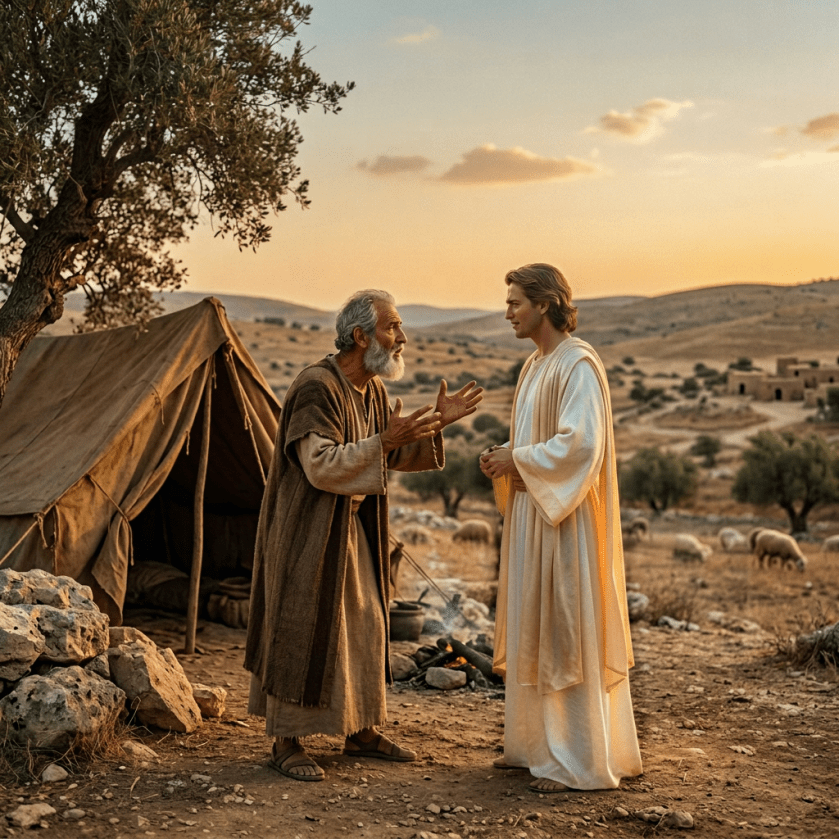
Genesis 18:22-33. 22So the men turned from there and went toward Sodom, but Abraham still stood before the Lord. 23Then Abraham drew near and said, “Will you indeed sweep away the righteous with the wicked? 24Suppose there are fifty righteous within the city. Will you then sweep away the place and not spare it for the fifty righteous who are in it? 25Far be it from you to do such a thing, to put the righteous to death with the wicked, so that the righteous fare as the wicked! Far be that from you! Shall not the Judge of all the earth do what is just?” 26And the Lord said, “If I find at Sodom fifty righteous in the city, I will spare the whole place for their sake.” 27Abraham answered and said, “Behold, I have undertaken to speak to the Lord, I who am but dust and ashes. 28Suppose five of the fifty righteous are lacking. Will you destroy the whole city for lack of five?” And he said, “I will not destroy it if I find forty-five there.” 29Again he spoke to him and said, “Suppose forty are found there.” He answered, “For the sake of forty I will not do it.” 30Then he said, “Oh let not the Lord be angry, and I will speak. Suppose thirty are found there.” He answered, “I will not do it, if I find thirty there.” 31He said, “Behold, I have undertaken to speak to the Lord. Suppose twenty are found there.” He answered, “For the sake of twenty I will not destroy it.” 32Then he said, “Oh let not the Lord be angry, and I will speak again but this once. Suppose ten are found there.” He answered, “For the sake of ten I will not destroy it.” 33And the Lord went his way, when he had finished speaking to Abraham, and Abraham returned to his place.
The plot continues to thicken in this wonderful yet strange visit of the Lord Jesus to Abraham at the Oaks of Mamre. It has become clear that this is no casual visit. The two angels have gone down to Sodom to see for themselves, and thus for God, what level of injustice is occurring in the city. This is the judge of all the world doing what is right. Seeing for himself. No hearsay. No failure to investigate. If there is going to be justice, first there is going to be truth.
It seems as though Abraham doesn’t need to investigate for himself. He knows the wickedness of Sodom. Remember, Abraham has come face to face with Sodom’s king (ch. 14). A man who, though rescued by Abraham, tried to control him with gifts that weren’t his to give in the first place. This is a king that wanted to steal the very souls of Lot and his family. Something, that we will see is about to happen.
Probably what stands out the most in this passage is not just Abraham’s prayer for Sodom, his enemy, but the way in which he prays. The haggling. It’s as if Abraham is at the flea market trying to earn the best possible deal on a pair of sunglasses. Of course, God is a terrible haggler. Everything Abraham suggests, he readily agrees to.
Will fifty righteous spare the city from destruction? Sure.
Forty-five? Why not?
Forty? Thirty? Twenty? Absolutely.
Ten, what about only ten? Deal – And the Lord went his way.
There’s much to see here about the nature of prayer. About what Tim Keller, called priestly intercession. Are we even allowed to talk to God this way? To bargain with him? Not only are we allowed to, we are expected to. Why? Because this kind of praying is rooted in two very important truths: the truth about the nature of God and the truth about the nature of Abraham’s relationship with God.
The nature of God.
It’s easy to see this prayer as an attempt by Abraham to change God’s mind, and on one level that’s what it is. But that’s not really what’s happening. Abraham is haggling with God (praying) based on the nature of God as righteous and just. The same God that declared Abraham to be righteous (15:6), and who just commanded Abraham to “do righteousness and justice” (18:19), must first be declared to be righteous and asked to do the same righteousness and justice that he demands from Abraham – Far be it from you to do such a thing, to put the righteous to death with the wicked, so that the righteous fare as the wicked! Far be that from you! Shall not the Judge of all the earth do what is just?
Abraham isn’t trying to change God at all, rather, he is fully relying on the unchanging nature of God to come through for Lot and all of Sodom. Abraham is counting on God’s character. His righteousness and justice. His mercy and grace. Yes, God has to uphold the standards of righteousness. But in his restorative justice, can God somehow salvage Sodom? Can such a wicked city be change for the good? Is it beyond reparation, beyond hope, beyond mercy?
Abraham is so persistent (even to the point of sounding annoying at worst and blasphemous at best) because he knows the character of Yahweh, his friend. He has tasted and seen that the Lord is good. He has been relying on the faithfulness of God for decades. He has been trusting that the Lord is merciful and gracious, slow to anger and abounding in love. Abraham is simply asking God to be who he is and always has been.
The nature of Abraham’s relationship with God.
Like you and I, Abraham is in a covenant relationship with God. The God who just placed a priestly calling on Abraham to do righteousness and justice based upon his own character. The God who just revealed his secret will to his friend Abraham. This is what gives Abraham (and us) the right to question God. Not questioning if he will be something different, but will he be the same.
Notice the question: Shall not the Judge of all the earth do what is just? We don’t question God’s decisions because we don’t like his character (a la Jonah). We question his decisions because we love his character. We are always invited before the King, who is also our Father, Bridegroom, and Friend, to ask him from our limited knowledge to change his mind, while trusting that in the end he will always do what is just.
The reality is that our prayers, even our haggling with God, doesn’t ever change the heart of God, the nature of God. Yes, our repentance can and does change the course of history, a history that God also knew before time. And yes, our pleading for those who might repent, as Abraham is doing here for Sodom, can also change the course of history. Consider Moses’ pleading for Israel, Jonah’s (horrible) sermon of God’s imminent wrath upon Nineveh, or Elijah’s divine threats to King Ahab. Each of these changed the trajectory of a nation.
But God’s foreknowledge also does not erase man’s free will, nor does it take away from God’s ability to respond to man’s free will. In short, God never changes in regards to his character or his covenant promises. But he can and does change in regard to his prophetic warnings. In fact, it is this changing that allows God to remain unchanging his nature. His loving, merciful, but also holy and just nature.
Praying for others, especially our “Sodoms,” is one of the greatest honors there is in the Christian life. Where else are we more like our Savior, THE Intercessor, then when we are loving our enemies and praying for them just as he commanded us to. Now this intercessory haggling is changing us, making us come face to face with the nature of God and our own sin in the process. Sin that Christ Jesus brought before the Father, pleading to spare the world, not for the sake of fifty, forty, or eve ten, but for the sake of one. The one and only righteous one in the “city.”
The Jesus who prayed for us from the cross, “Father forgive them,” intercedes for us still, for we still know not what we do. And yet, in covenant with God through Christ, we are called to pray for the perishing. In the words of the King of Nineveh, “Who knows? God may turn and relent and turn from his fierce anger, so that we may not perish.”
You: Does your prayer life sound anything like Abraham’s in this passage? In what way?
You in Christ: How does being in covenant with God allow us to approach God as Abraham did, boldly and secure in his character?
Christ in you: Is there an enemy in your life that you might intercede for today?
Prayer: Father, your word says that none of us is righteous on our own. We all need the intercession of Jesus. Thank you for preserving me for the sake of the One, your Son, Jesus. Amen.

