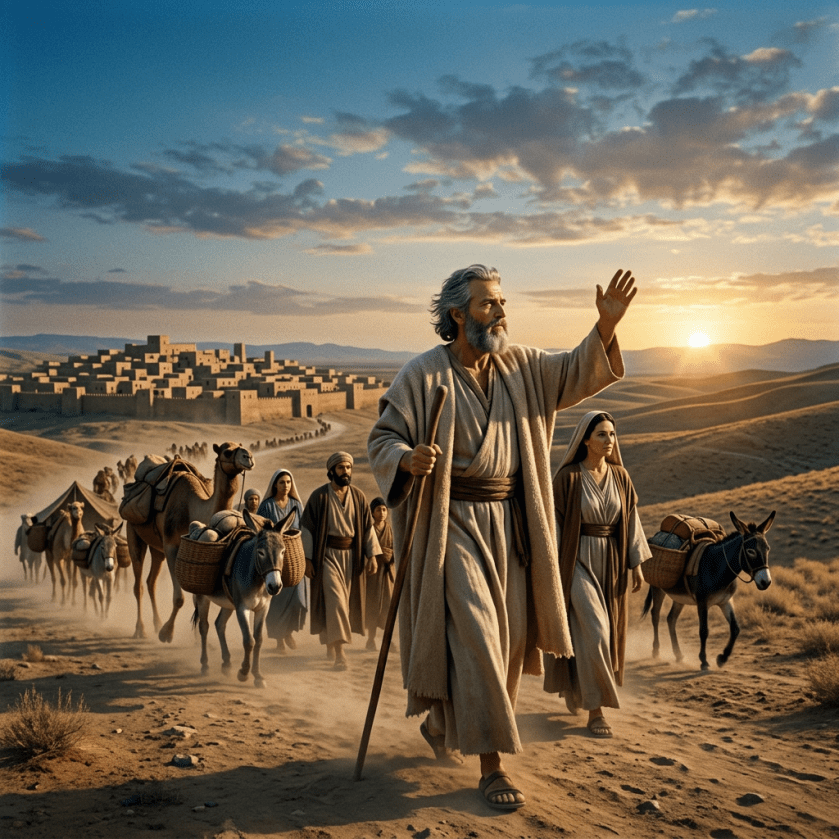
Genesis 12:1-3. 1Now the Lord said to Abram, “Go from your country and your kindred and your father’s house to the land that I will show you. 2And I will make of you a great nation, and I will bless you and make your name great, so that you will be a blessing. 3I will bless those who bless you, and him who dishonors you I will curse, and in you all the families of the earth shall be blessed.”
Here is the famous call of Abraham. God speaks to Abram and calls him to go. Go to an unknown land that God will show to him. We call it the Promised Land. Canaan. This call will require a journey, a lifetime of movement and wandering. It will require faith.
God’s call comes with covenant promises attached. One of these promises is that God will make Abraham’s name great. A great nation with a great name. A legacy. Isn’t that what we all want, to be remembered after we are gone? To have our names on the side of a building, or our portrait hanging up somewhere, or even just a nice epitaph on our tombstone. But the truth is very few people are actually remembered a hundred years after they die. Can you even name your great grandparents?
The truth is that God’s promise to Abraham of a great name is quite surprising following on the heels of the tragic Tower of Babel story. You may remember that the tower fiasco was connected to their desire to “make a name for themselves.” To establish their own legacy of power through their knowledge of good and evil. We know that God shut down their legacy of narcissism and oppression, scattering the tribes across the globe. So why would God risk the same danger by creating a great nation with a great name? Won’t they just become tower builders too?
God decides to “risk” it all (not really, an all-knowing God never takes risks) on this man Abraham. Why? Why Abraham of all people?
Of course, the short answer is grace. Abraham came from a family of moon worshipers living in a pagan city that had altogether rejected Yahweh. Yet Abraham is the descendant of Shem, the blessed son of Noah. God had promised that the tents of Shem would be honored. And yet, this is still grace. Undeserved favor for Abraham.
The question is, can God trust Abraham with this great name that he will give to him? Can God trust Abraham with a legacy that will make his family into a great nation? Is there anything that reveals that Abraham can be trusted with this gracious act, unlike the Babel-onians before him? There might be. To see it we have to go back to Genesis 11.
Genesis 11:27-30. 27Now these are the generations of Terah. Terah fathered Abram, Nahor, and Haran; and Haran fathered Lot. 28Haran died in the presence of his father Terah in the land of his kindred, in Ur of the Chaldeans. 29And Abram and Nahor took wives. The name of Abram’s wife was Sarai, and the name of Nahor’s wife, Milcah, the daughter of Haran the father of Milcah and Iscah. 30Now Sarai was barren; she had no child.
We get a glimpse into the heart of Abraham in this short genealogy. In it we see that Abraham had a brother that died, Haran. Haran had two daughters, Milcah and Iscah. Most scholars agree that Iscah and Sarai are the same person. What does this mean? It means that Abraham married his brother’s daughter, his niece, Sarai. Why would he do that? Because this marriage would protect Sarai and preserve the legacy of Haran, his brother. Not his own legacy. Not his own name. His brother’s name.
This was a righteous and selfless act by Abraham that shows that just maybe he won’t be an egomaniacal tower builder like his forefathers. And in fact, the only permanent structure Abraham ever built was an altar to God. No towers. No cities. No palaces.
Hebrews 11:9-10. 9By faith [Abraham] went to live in the land of promise, as in a foreign land, living in tents with Isaac and Jacob, heirs with him of the same promise. 10For he was looking forward to the city that has foundations, whose designer and builder is God.
Beyond this, Genesis 11 reveals the devastating fact that Sarah turns out to be barren. But did young Abraham abandon her? Did he move on to another wife that would propagate his own legacy and honor with offspring? It appears not. We know from the scriptures that, instead, Abraham adopted his brother’s son, Lot, as his own.
What is Abraham’s legacy? Is it not that he didn’t care about his own legacy? He cared about his brother, his family, their honor and their safety. Not his own. And when the gracious promise came he responded in selfless faith moving toward an unknown land with his barren wife and adopted nephew.
Whose legacy are you building? Is it your own, or is it your brother’s? Your older brother, Jesus? Are you making choices based on his honor or your own? In Christ, we have been given his great name. We are a part of his great nation. His name is our strong tower, our glory, our honor, our legacy. May his name be praised forevermore.
You: Whose legacy are you building? Whose fame does your life spread?
You in Christ: How does being in Christ give you an eternal legacy that can never be taken away or forgotten?
Christ in you: How can you abandon making your own name great and instead make the name of Jesus great at work, at home, in your community?
Prayer: Father, you have given Jesus the name above every name and written the name of Jesus on our foreheads. Let me live for his name alone today. Amen.

