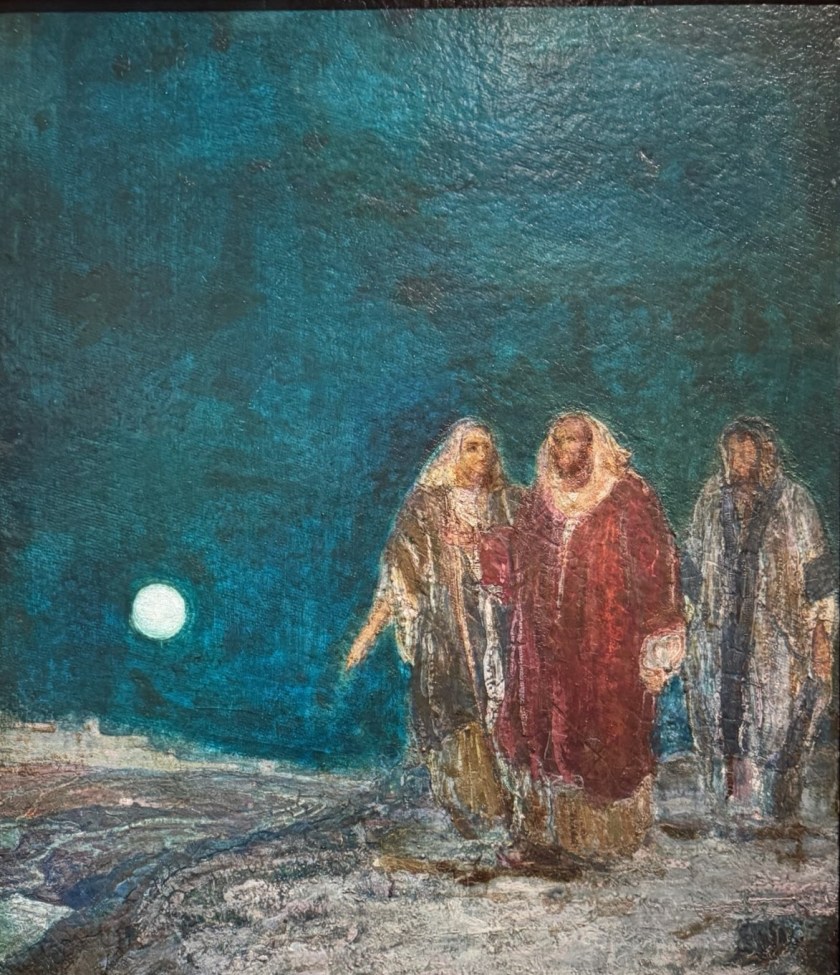
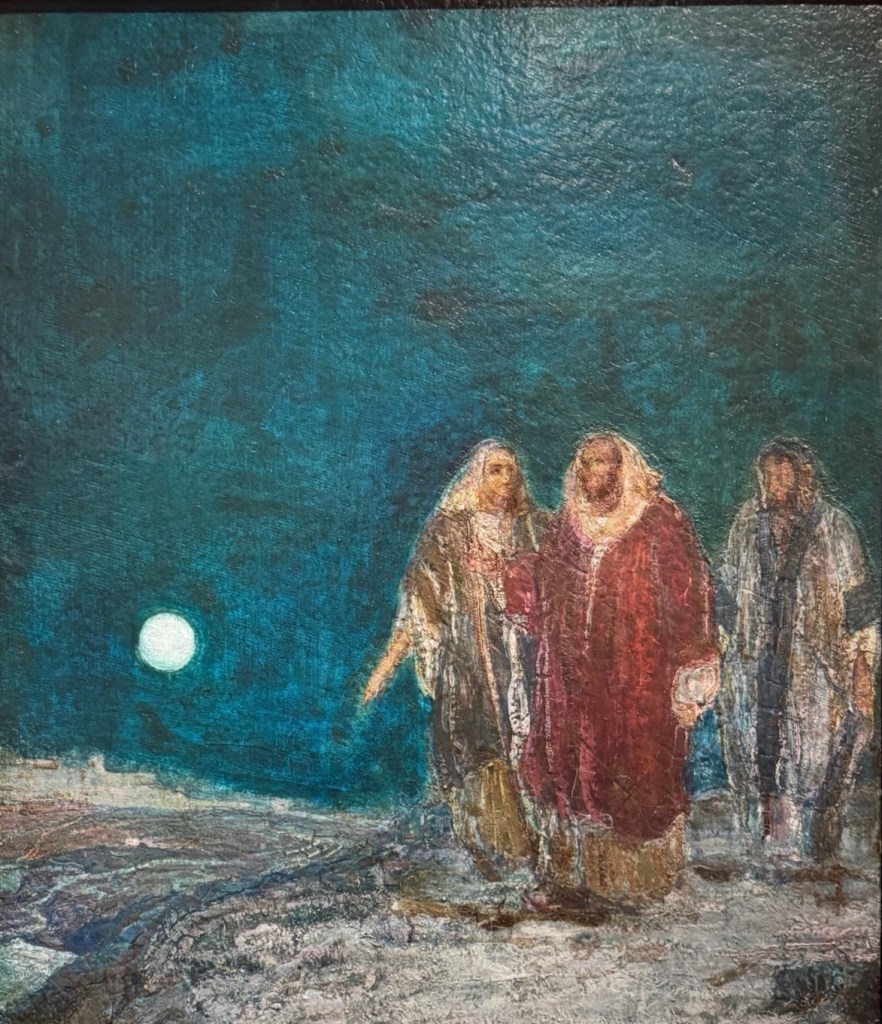
Luke 24:13-16. 13That very day two of them were going to a village named Emmaus, about seven miles from Jerusalem, 14and they were talking with each other about all these things that had happened. 15While they were talking and discussing together, Jesus himself drew near and went with them. 16But their eyes were kept from recognizing him.
Have you ever felt hopeless? The two disciples that the resurrected Jesus encounters on the road to Emmaus are hopeless. They have just watched Jesus be crucified by the Romans at the behest of their own religious leaders, and on top of that his dead body has been stolen from the tomb and nobody knows where it is. In their own words, “We had hoped that he was the one to redeem Israel.”
(There is also a strong case to be made for these two travelers being the uncle and aunt of Jesus. Luke names Cleopas, which is also the name of his uncle. John names Cleopas and Mary at the cross witnessing the crucifixion, John 19:25. This would, of course, add to the despair of these two precious disciples.)
The key phrase here is this one: But their eyes were kept from recognizing him. Then, in almost comedic fashion, Jesus will “play dumb” about what has taken place in Jerusalem.
“What are you talking about?” Jesus asks as he catches up with them on the road.
“Are you the only visitor to Jerusalem who does not know the things that have happened there in these days?” they reply.
“What things?” said Jesus.
“Concerning Jesus of Nazareth, a man who was a prophet mighty in deed and word before God and all the people,” they answered.
Oh the irony of explaining Jesus to Jesus. Don’t you know anything, Jesus? How many times have we all questioned Christ’s knowledge of the things going on in our world? Surely I know more about this situation than Jesus does.
The saddest part of all this isn’t just that they couldn’t recognize Jesus on the road, but that they didn’t recognize Jesus in real life. “We thought he was a prophet mighty in deed and word.” Of course Jesus was those things, but he was so much more. They wanted a newer, better Moses. THE Prophet predicted in Deuteronomy 18. They wanted an emancipator, a liberator from their “Egypt,” Rome. God’s Messiah without the suffering servant part. A “Redeemer for Israel.”
These two disciples were what Martin Luther called Theologians of Glory, as opposed to Theologians of the Cross. Theologians of Glory want to skip over the cross and the resurrection and head straight to glory. In this case the glory of a Messianic reign in Israel. But a dying messiah was simply not in their worldview. And neither was a resurrection.
Jesus won’t let them be Theologians of Glory. He won’t let them overlook the necessity of the cross. This is why he confronts them and questions them – What things? he asks.Obviously Jesus knows the answer. He IS the answer. But he must press on their wounded hearts so as to expose them. They are “foolish and slow of heart,” Christ says (v.25).
And so are we. We too want to move through the work of the cross in our lives as quickly as possible if at all. We too want a mighty prophet rather than a merciful savior. A God who changes our circumstances without needing to change us.
But the resurrected Jesus won’t allow this. From his place of glory, he will always take us backwards to the cross. To his suffering and our suffering with him.
Luke 24:25-27. 25And he said to them, “O foolish ones, and slow of heart to believe all that the prophets have spoken! 26Was it not necessary that the Christ should suffer these things and enter into his glory?” 27And beginning with Moses and all the Prophets, he interpreted to them in all the Scriptures the things concerning himself.
The Christ should suffer.
And so should the Christian.
The suffering of Christ is the testimony of all of scripture. From the ram sacrificed for Isaac to the Passover lamb, from wrestling Jacob to weeping Jeremiah, from the mocking of Noah to the murder of Amos, from Psalm 22 to Isaiah 53, from Yahweh mocked in 2 Kings to Yahweh pierced in Zechariah, Jesus’ suffering and death is the plan of God for our salvation.
And our suffering and dying is the plan for our sanctification in Christ. In our hopelessness Jesus walks with us along the path of suffering. In our blindness to his presence, Jesus asks us to open up about the things that tear at our heart. What things? he asks in gentleness, revealing to us what indwelling sin must still die from within. Then he reveals himself, his own suffering, his own death, and his own resurrection to us from the scriptures. He reminds us of the pattern of his own life – first the cross, then glory (v.26).
In Christ this pattern is possible. We have already died with him to sin and have been raised with him to God. Now we can do the daily work of exposure and extinction. We can let our mighty prophet first be our merciful savior.
You: Are you a Theologian of Glory or a Theologian of the Cross?
You in Christ: How does our dying and rising with Christ allow us to use our suffering to expose our sin and put it to death?
Christ in you: How have you been able to use all of scripture to see the Suffering Servant, Jesus?
Prayer: Father, I don’t want to be blind to Christ. Open the eyes of my heart to see my suffering Savior and the path we walk together. Amen.

